Home / Sports & seasonal gear storage
What to organize
Organize sports balls. Contain the rolling group while keeping one-ball pickup easy.
Sports balls
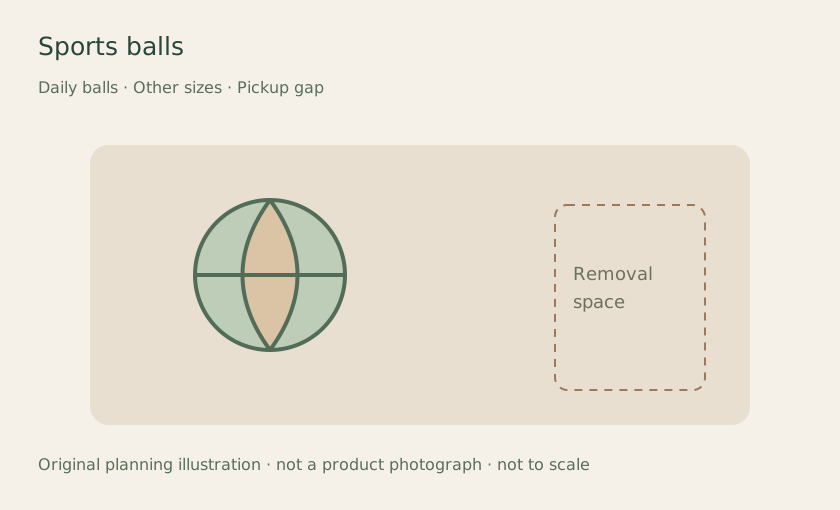
Original layout illustration · not a product photograph · not to scale. The image opens an Amazon category search, not an exact offer. Build a system you can keep using Group balls by the sizes and routines you actually use. Follow maker care and storage directions; do not alter inflation just to fit a holder. Choose access that allows the bottom group to be reached. Map these parts of the layout Daily balls Other sizes Pickup gap Check the fit before filling it Measure the actual largest ball and the smallest item that could pass an opening. Check usable depth, loaded projection and the removal movement. Keep it looking put together. A defined ball boundary is calmer than a loose row spreading across the floor.
Avoid: Assuming a cage opening or advertised count suits every ball size.
Choose the location after checking the gear directions. A transport pack size is not automatically the right long-term storage shape. Follow the selected gear’s current care instructions and location requirements. A rack, sack or tote does not make damp gear ready to store or every garage suitable.
Primary examples reviewed 2026-11-16: NEMO’s tent-care guidance calls for dry components and a particular long-term storage approach. Its sleeping-bag care page gives separate storage directions. Confirm the instructions for the exact model; these examples do not establish a universal compression rule, organizer fit or protective performance.
Connected organizing ideas Choose openings around the largest and smallest balls.
Make a mixed kit visible without losing the last item.
Give the packed bag a return position after the care routine.
Editorial organization planning, not hands-on product testing or a tool/part compatibility guide. Retain original identifiers and follow the applicable product instructions.